Why is Sample Development So Expensive When Bulk Production is Not?
As a potential new customer sourcing clothing from Homotex, you might be surprised by the initial cost of sample development. You look at our website and see that we have no Minimum Order Quantity (MOQ) and that our bulk pricing is quite competitive. Then, you receive a quote for a single prototype and wonder: why is this first step so expensive?
It’s a valid question, and one we encounter frequently. At Homotex, we are committed to helping new brands grow, but it is essential to understand that the initial sample is not just a piece of clothing; it is a full engineering and design process condensed into one item.
Let’s break down the reasons why sample development seems costly and how that investment directly leads to your (and our) future success.
The True Cost of a Prototype
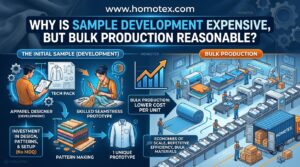
Developing a sample is a labor-intensive, multi-step process. Here’s a closer look at what your development fee is funding:
1. Technical Design and Tech Pack Creation
Before a fabric is cut, our designers and engineers must translate your design concept—whether from a sketch, a mood board, or a reference garment—into a detailed technical package (a “Tech Pack”). This includes precise measurements, bill of materials, stitch specifications, grading rules, and construction call-outs. This is highly skilled work and serves as the master blueprint for everything to follow.
2. Pattern Making and Grading
A physical pattern (or a 2D/3D digital model) must be created by a professional pattern maker. This pattern is then graded into different sizes. Unlike digital designs that can be resized instantly, physical clothing grading requires a meticulous understanding of fit and how a garment changes across a size run. Creating this master pattern is a significant one-time cost.
3. Sourcing and Procurement
Even for a single sample, we must source specific fabrics, custom trims, buttons, zippers, and threads. Buying small quantities of specialized materials (e.g., getting only 5 meters of a specific performance knit) is extremely expensive on a per-unit basis. Often, the shipping cost of these materials exceeds the material cost itself. We must dedicate personnel time to finding these resources and arranging for their expedited delivery.
4. Setup and Tooling
The factory’s equipment—cutting machines, sewing tables, and specialized machinery—must be set up for your unique garment. In bulk production, this setup time is amortized over thousands of units, making the per-unit setup cost negligible. For a sample, the entire setup cost is absorbed by just one or two items.
5. Skill and Attention to Detail
A development sewer is one of the most skilled workers in the garment factory. Their job is not to repeat the same stitch thousands of times; their job is to figure out how to make your unique garment. This is slower, artisanal work that commands higher labor costs compared to bulk assembly. Every detail—from the seam allowance to the placement of a label—is analyzed and refined.
Understanding the Difference: Bulk Production
Now, let’s contrast that with why our bulk prices are so reasonable. When you move from sample to full production, the economies of scale take over.
- Lower Labor Costs: The sample was slow-cooked; bulk is efficiency. Workstations are set up for continuous production, allowing lower-skilled workers to perform repetitive tasks quickly and accurately.
- Bulk Purchasing Power: We order fabric by the bolt, trims by the thousands, and buttons by the gross. This bulk ordering significantly reduces the per-unit material costs and shipping.
- Amortization of Initial Costs: The costly patterns, Tech Packs, and setup fees are all behind us. These fixed costs are now spread across many units, making the initial investment seem much more valuable.
Why Investing in a Strong Sample is Crucial
Think of the high initial sample fee not as a “markup,” but as an investment in the quality and manufacturability of your product. A properly developed sample at Homotex will:
- Ensure Perfect Fit: Mistakes on a single sample are cheap; mistakes on a 5,000-unit bulk run are devastating. This is the stage to lock in your fit.
- Create the “Golden Sample”: This sample is the final, approved prototype that acts as the quality benchmark against which all of your bulk production will be measured.
- Validate Material Choices: Does the fabric drape the way you intended? This is the only stage to make sure.
Our no-MOQ policy allows you to scale up at your own pace, which is a rare and powerful offering. The best way to leverage this advantage is to commit to a solid, well-developed initial sample, which will ultimately reduce your risks and maximize your profit potential when your brand starts to take off.